
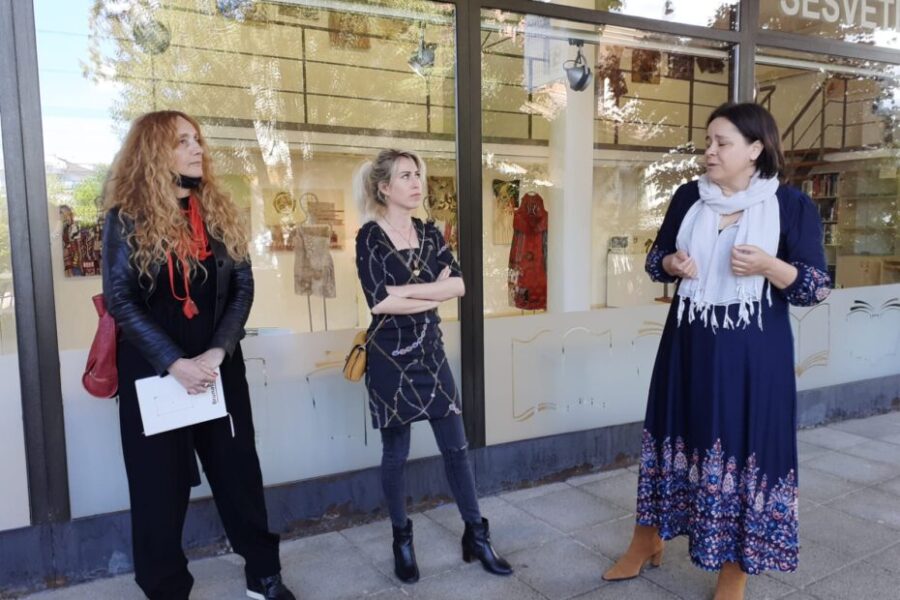
In the Oblok Gallery of the Sesvete Library, which is an integral part of the National University of Sesvete, a very interesting, but also unique exhibition was presented on Saturday, May 8, which presented the young Croatian designer Lada Tomašić
She is considered a pioneer of the Croatian textile and art scene, because the first of the young generation of Croatian artists dared to use textile design, which she received her master’s degree, exclusively for artistic purposes, creating wonderful textile paintings.
The first thing most of us think of when we say or hear the term “textile painting” is tapestry and tapestry or those antique embroidered cloths that adorned the kitchen walls of our great-grandparents.
Then, we were sure to come across original blankets and rugs made in the patchwork technique, wearing or noticing on others various garments with a variety of textile applications.
And I’m not talking about the richness of folk costumes until the 70’s of the last century popular patches that are back in fashion adorning pants (on the knees) or sleeves of jackets and coats.
And textile painting, not as a useful object, but artistically appeared in Japan, then in England and America, and in Russia, ie in the countries of the former USSR, making objects of applied art from textiles was very popular and widespread.
There are various techniques for making such textile items, but also the mentioned textile paintings. From Japanese Kinusayga or Osie, and the aforementioned patchwork, “stitching”, string art (thread making), from lace; from felt, from jeans, the “wet cloth” technique and many others.
And Lada Tomašić, the author we present today, makes textile paintings with a unique technique she designed, combining several techniques with incredible freedom, approaching the textile canvas as a painting in which she “builds” her artistic-textile sensation with pieces of various fabrics, which become particles of the painting. sewing and sewing them with a thread that becomes a line, “drawing” a subtle but miraculous textile image.
She uses pieces and pieces of fabric of various patterns, creates from them interesting morphologies, biomorphic, but often geometric forms, releasing the material of the original usable function, making it a segment of its unique artistic image. Lada combines materials of different patterns, textures and colors, approaching them completely freely and inventively.
This is how paintings are created, or as her mentor Koraljka Kovač called them, textile installations. In support of this, this exhibition is evidenced by the items that the author exhibited in addition to the paintings, such as clothing – jackets, corsets, kimonos and ties, all the way to the shade of lamps. Well, everything that she “sewed” into her painting with her creative inventiveness, now acquires a new meaning in these pieces of applied art, becomes a truly artistic installation, because it goes beyond the very use value of the exhibited object.
And everything is old, already seen and used, now recycled, and yet so special and new in the way the textile is presented, in the way it is made, the expression. all the way to the shade of the lamps. Well, everything that she “sewed” into her painting with her creative inventiveness, now acquires a new meaning in these pieces of applied art, becomes a truly artistic installation, because it goes beyond the very use value of the exhibited object. And everything is old, already seen and used, now recycled, and yet so special and new in the way the textile is presented, in the way it is made, the expression. all the way to the shade of the lamps.
Well, everything that she “sewed” into her painting with her creative inventiveness, now acquires a new meaning in these pieces of applied art, becomes a truly artistic installation, because it goes beyond the very use value of the exhibited object. And everything is old, already seen and used, now recycled, and yet so special and new in the way the textile is presented, in the way it is made, the expression.
It is an art built on a miraculous dichotomy that gave textiles and design a new, deeper meaning and which now presents creation as a creative act, a gift of God which, unfortunately or fortunately, is not given to everyone, but those to whom it is given should “materialize” it. and to give to others as a unique creation. Lada Tomašić does that, proving it with this exhibition as well.
Autor: Sanda Stanacev Bajzek